
Yes, but far less than the internet warns. Cash in Japan in 2026 is a floor, not a wallet: cards and phone payments cover the chains, hotels and city restaurants, an IC card handles the small taps, and ¥5,000 to ¥10,000 in notes covers the market stalls, temple counters and tiny restaurants that still, wonderfully, run on yen.
The cash in japan question produces two wrong answers online: the outdated one, that Japan is a cash-only country, and the newer overcorrection, that you can tap your way through everything. We live here, and daily reality in 2026 sits precisely between: a three-layer system of card, IC and cash that residents run without thinking, and that takes a visitor one paragraph to learn.
Here is that system, where each layer actually applies, and the refill pattern that means you never think about money logistics again after Day 1.
Our cheku 9 Days in Tokyo guide handles the broader Tokyo planning — 106 pages of routing, local restaurant picks, and our photography, designed for a full trip not just an afternoon. Live on Kickstarter until July 26. Reserve yours now at the best prices we'll offer.
Where do cards now work without a thought?
Most of the trip's big spending: hotels, department stores, chain restaurants and shops, city taxis, shinkansen tickets. If the place has a logo you have seen twice, your card works.
The card layer has quietly won the mainstream. Hotels and department stores have taken cards for decades; the chains, restaurant, coffee, retail, all tap now; city taxis display the payment logos on the window; and long-distance travel is card territory end to end, from shinkansen tickets to airport trains. On a first-trip route through Tokyo, Kyoto and Osaka, a visitor could put the large majority of total spend on a card without once being refused.
Which is exactly what makes the remaining cash territory confusing to newcomers: it does not correlate with price or polish. It correlates with size and age of the business, and that is the map the next section draws.
Where does cash still rule in 2026?
The places you came for. Small independent restaurants, market stalls, temple and shrine counters, old izakaya, festival food rows, rural everything. The best meals of your trip are disproportionately yen-only.
Our honest resident's list of where notes and coins remain the only language:
Market stalls and food halls → the morning tuna-and-tamagoyaki breakfast is a cash transaction Temple and shrine counters → admissions, amulets and goshuin stamps, coins and small notes Small independent restaurants → the six-seat ramen counter, the family soba shop, many ticket machines Old-school izakaya and yokocho bars → lantern alleys largely predate the card reader Festivals and street food → matsuri stall rows are a cash economy, full stop The countryside → small-town cafes, rural buses, roadside stands: assume yen
Notice the pattern: the cash zone maps almost perfectly onto the "authentic Japan" zone every visitor is hunting. Carrying cash is not a logistics chore. It is the entry ticket to the parts of the trip that do not have a logo.
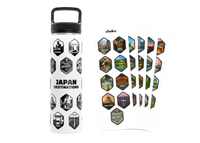
❤️ For first-time Japan visitors, the Traveler bucket-list bottle celebrates 27 destinations along the Golden Route — Tokyo neighborhoods and day trips included. A travel guide, souvenir, and reusable bottle rolled into one. Live on Kickstarter until July 26. Reserve yours now at the best prices we'll offer.
How does the three-layer system work?
Card for the big and planned, IC for the small and constant, cash for the special and stubborn. Each layer has a job, and the table settles which.
| Credit card | IC card (Suica/Pasmo) | Cash | |
|---|---|---|---|
| Handles | Hotels, shinkansen, chains, shopping | Trains, konbini, vending, lockers | Markets, temples, small restaurants |
| Typical amount | ¥3,000+ | Under ¥1,000 | ¥500–3,000 |
| Speed | Normal | Instant tap | Tray ritual |
| Refill | n/a | Machines, or cash top-up | Konbini ATM |
| Best for | The planned spending | The daily rhythm | The trip's best detours |
The middle layer deserves its own word, because visitors underuse it. Per japan-guide.com, the transit IC cards double as e-money at convenience stores, vending machines and coin lockers across the compatible network, which turns the card you got for trains into the fastest wallet in the country for small purchases. Which IC card to get, and why the app version wins for iPhone users, is its own decision; we settled it in Suica vs Pasmo.
Free for you: our Tokyo Google Maps list We keep a Google Maps list of the must-see spots around Tokyo - restaurants, cafes, shops, viewpoints, and streets worth the detour. Drop your email and we'll send it over.
How much cash should you actually carry?
A refillable floor of ¥5,000 to ¥10,000 per person. Withdraw at convenience-store ATMs, which take foreign cards, whenever the floor dips. Skip the airport exchange counter entirely.
The resident pattern is a floor, not a budget. Keep ¥5,000 to ¥10,000 in your wallet as standing equipment, spend it on the cash-zone moments above, and refill at any convenience-store ATM, which accept foreign cards and outnumber almost every other kind of infrastructure in the country. No airport exchange desk, no giant Day-1 withdrawal riding around in your bag all trip, no mental arithmetic.
Two refinements from daily life here. Keep coins deliberately rather than fighting them: ¥100 pieces feed coin lockers, laundry machines and vending machines constantly, and a small coin purse stops being funny the first week you live with yen. And when paying by card abroad-style, if a terminal offers to charge you in your home currency, decline and pay in yen; the convenience conversion is never in your favor.
What is the etiquette around paying?
Two habits cover everything: money goes on the small tray, not hand to hand, and nothing is ever tipped, anywhere, to anyone.
Payment in Japan has a choreography, and it is easy to join. Nearly every register presents a small tray: notes and coins go on it, change and receipt come back on it, and the whole exchange happens without money changing hands directly. Use the tray and every transaction smooths out.
And the rule that saves visitors real money and real awkwardness: there is no tipping. Restaurants, taxis, hotels, guides, hairdressers, nobody, nowhere. The price is the price, the service is excellent because that is the standard, and attempted tips are met with polite confusion or a determined chase down the street to return your change. The wider etiquette layer, and the rest of the arrival setup, lives in our 30 Japan travel tips, the companion read to this one.
So: do you need cash in Japan in 2026? Enough to say yes to the six-seat counter, the shrine stamp and the festival stall without a second's hesitation. That is not a burden. It is the price of admission to the best parts, and it fits in one trouser pocket.
❤️ The cheku 9 Days in Tokyo guide is our 106-page deep-dive for first-time Tokyo visitors who want a full itinerary they can hand to themselves — with our photography embedded throughout. Live on Kickstarter until July 26. Reserve yours now at the best prices we'll offer.
FAQ
Can you visit Japan without cash in 2026?
You could survive, but you would eat and shop worse. Cards and phone payments now cover chains, hotels, department stores and most city restaurants, yet the small independent places that make a Japan trip, market stalls, temple counters, old izakaya, still run on yen. Carry some; it buys the good detours.
How much cash should I carry in Japan?
A floor of ¥5,000 to ¥10,000 per person, refilled as it dips. That covers the day a small restaurant, a shrine amulet and a market snack all turn out to be cash-only. Big planned purchases go on cards. The floor is for the unplanned things, which in Japan are the point.
Where do I get yen in Japan?
Convenience-store ATMs, which accept foreign cards and are everywhere from city corners to small towns. The resident pattern is simple: withdraw moderate amounts as needed rather than one airport lump, and skip airport exchange counters entirely. Your bank card plus a konbini is the whole system.
Is tipping expected anywhere in Japan?
No, nowhere: restaurants, taxis, hotels, guides. The price is the price and excellent service is the default. Attempting to tip usually produces polite confusion or a staff member returning your money. Put payment on the small tray at the register and say thank you; that is the whole ritual.
What are IC cards like Suica actually for?
The middle layer between cash and cards. Loaded once, they tap through trains and buses, then keep paying at convenience stores, vending machines and coin lockers across the compatible network, per japan-guide.com. For sub-¥1,000 daily spending they are faster than either alternative, which is why residents default to them.
Sources
- japan-guide.com — Prepaid IC Cards in Japan — IC e-money coverage at convenience stores, vending machines and lockers, and card mechanics (fetched 2026-07-17)
Activities and tours in Tokyo
cheku is a GetYourGuide partner. We link to tours that handle the parts of travel that eat your time, getting there, booking ahead, language, context you'd otherwise miss. If you book through our link, we earn a small commission at no extra cost to you.


