
The Golden Route is Japan's standard first-trip circuit: Tokyo, Hakone and Mount Fuji, Nagoya, Kyoto, Osaka, strung along one shinkansen line. Japanese industry sources define it as a 5 to 10 day product. The places are right. The pace is the part to question, and this guide shows you which legs earn their days.
Search for a first Japan itinerary and nearly every result is the same trip wearing different names. Tokyo first, Mount Fuji somewhere in the middle, Kyoto near the end, Osaka to fly home. That sameness has a reason. The trip has a name in the Japanese travel industry: the Golden Route, ゴールデンルート, and it was designed as a product long before it became your itinerary.
Reading the Japanese sources that define it changes how you plan it. They are open about why the route exists, who it was built for, and where it strains. This guide translates that framing, lays the route out leg by leg with verified fares, and gives you an honest read on which stops deserve nights and which are better passed through.
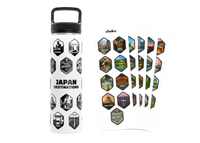
If you are mapping out a first trip around these destinations, the Traveler Bottle I covers 27 of them in one piece — designed for first-time visitors who want the route that actually fits in two weeks.
What is the Golden Route in Japan?
The Golden Route is the inbound-tourism industry's name for Japan's standard visitor circuit: Tokyo, the Hakone and Mount Fuji area, Nagoya, Kyoto and Osaka. The Japanese glossary definition calls it a roughly 5 to 10 day trip.
The term is industry language, not something Japanese travelers say about their own trips. The inbound-tourism glossary at honichi.com defines the most popular version as a circuit of six places, 東京・箱根・富士山・名古屋・京都・大阪, Tokyo, Hakone, Mount Fuji, Nagoya, Kyoto and Osaka, typically completed in roughly 5 to 10 days. A honichi.com trade explainer describes the same shape as the five most popular areas a visitor can cover in a short stay.
The geography does the explaining. Every stop sits on or beside the Tokaido Shinkansen, the train line connecting Tokyo to Osaka. The route is not a considered tour of Japan's best places. It is the line the fastest train happens to draw, with the country's two most famous cities at either end and its most famous mountain in between.
That is not a criticism. The stops are genuinely the right introduction to the country. But knowing the route is an industry product, with an industry logic, is the first step to using it well rather than being used by it.
Why does the Golden Route exist?
Because most first visits are short. Japanese trade media points to an average stay of about six nights, and the route compresses the metropolis, the mountain and the old capital into the one line that fits that window.
The honichi.com explainer, written for the Japanese tourism industry in 2019, is direct about the design constraint: visitors at the time averaged "平均6.0泊", six nights in the country. Six nights is not enough time to explore Japan. It is enough time to be routed through it. So the industry built a route that delivers the three things a first visit wants, the modern capital, the countryside with Mount Fuji in the frame, and the temples of the old capital, with the shinkansen doing the connecting.
The same piece publishes a seven-day example that arrives at Narita Airport and departs from Kansai International near Osaka. That open-jaw shape, flying into one end of the line and out of the other, is the route's cleverest feature, and it is worth stealing whatever length your trip is. No backtracking, no wasted final day returning to Tokyo.
Understanding this history reframes the planning question. The Golden Route was optimised for six nights. If you have ten or fourteen, you are not obliged to inherit its compression. You can keep its stops and give them the days the original product never could. That longer version is exactly what we build in our two-week Japan itinerary.
What does a Golden Route itinerary look like day by day?
The industry's own example is seven days: Tokyo, a Hakone or Fuji day, the shinkansen west to Kyoto, and Osaka to fly out. Stretch the same skeleton to ten or fourteen days and the route changes character completely.
The honest way to present the route is as one skeleton at three speeds. The stops barely change. The experience changes entirely.
| 7 days | 10 days | 14 days | |
|---|---|---|---|
| Tokyo | 3 nights | 4 nights | 5 nights |
| Hakone / Fuji | Day trip | 1 night | 1 night |
| Kyoto | 2 nights | 3 nights | 4 nights |
| Osaka | 1 night | 2 nights | 2 nights |
| Nara | Not this trip | Half day from Kyoto | Full day from Kyoto |
| Flex days | None | None | 2 (Hiroshima, or slower everything) |
| Feels like | A routing | A trip | A trip with room to breathe |
| Best for | Only week you'll ever have | Most first trips | First trips that want depth |
The night counts are not ours. Japanese sources publish them. The travel.co.jp guide on how many nights Kyoto needs puts the major sights at 1 to 2 nights, with two or more days opening the outlying areas, and JR Central's travel arm builds its standard Kyoto course as 2 nights and 3 days. The Osaka guide from the same site puts an Osaka stay at 1 to 2 nights.
Whether Tokyo plus Kyoto alone is already enough for your first trip is its own decision, and we made the case for it in Tokyo and Kyoto: is it enough? The short version: at ten days or fewer, two anchors beat five stops.
❤️ The Traveler bucket-list bottle covers the first-trip essentials — 27 destinations along the Golden Route, designed for first-time Japan visitors. The Explorer Bottle is its companion for repeat travelers going deeper. Live on Kickstarter until July 26. Reserve yours now at the best prices we'll offer.
How do you travel between the Golden Route cities?
One train line does almost all of it. The Tokaido Shinkansen runs Tokyo to Kyoto in about 140 minutes on a Nozomi, ¥13,320 for a non-reserved seat, and Kyoto to Osaka is one stop further.
The logistics are the easiest part of the route, which is precisely why the route exists. Per japan-guide.com, the Tokyo to Kyoto leg costs ¥13,320 non-reserved or around ¥14,000 reserved, taking about 140 minutes on the fastest Nozomi trains and about 160 minutes on the Hikari. Trains leave Tokyo Station many times an hour through the day. You do not plan around the shinkansen. You show up to it.
We broke down every option for that leg, including when a reserved seat is worth it and what to do with luggage, in our Tokyo to Kyoto guide.
The question every first-timer asks next is the JR Pass, and the answer from Japanese-facing sources is clearer than most itinerary blogs make it. The 7-day ordinary pass costs ¥50,000 as of 2026, per japan-guide.com's pass guide, and that same guide states plainly that the pass "will be more expensive than regular train tickets or flights for most itineraries." A one-direction Golden Route is exactly the kind of trip it does not pay for. Two shinkansen legs and some city travel come nowhere near ¥50,000. Buy point-to-point tickets, put an IC card on your phone for everything inside the cities, and keep the difference for dinner.
If your budget is doing the deciding, the same japan-guide page notes discount highway buses run Tokyo to Kyoto from around ¥4,000. The trade is seven to eight hours of your trip.
Do Hakone and Nagoya deserve their days?
Hakone earns a night as the slow, hot-spring counterweight to the cities. Nagoya, for most first trips, is a city the shinkansen passes through on the way to Kyoto.
The six-place glossary definition includes two stops that first-timers agonise over. They are different decisions.
Hakone is on the route as the nature interval: the hot-spring town in the hills where Mount Fuji appears across a lake on clear days. Its value is the change of register, one night at a slower pace between the two big cities, an onsen bath instead of another train platform. If your trip is ten days or longer, it is the stop we would protect.
Nagoya appears in the definition because it sits on the line, a major city with a proud food culture and a castle. On a first trip with limited days, it is competing directly with Kyoto for your time, and that is not a fair fight. Japanese model courses for first-trip planning consistently spend those days in Kyoto's areas instead. Nagoya rewards a return visit better than it rewards a first-trip detour.
Go to Hakone if: you have ten days or more and want one night that feels like a different country from Tokyo. Pass through Nagoya if: this is your first trip and the day would otherwise come out of Kyoto.
Free for you: our Tokyo Google Maps list We keep a Google Maps list of the must-see spots around Tokyo - restaurants, cafes, shops, viewpoints, and streets worth the detour. Drop your email and we'll send it over.
How do Japanese travelers use the same places?
Differently, and the difference is the useful lesson: area by area rather than city by checklist. じゃらん presents Kyoto to domestic travelers as nine separate model courses, each one walkable in a day or less.
Japanese travelers do not follow the Golden Route. It was never for them. But they visit the same places, and how they structure those visits is worth copying. A じゃらん guide to Kyoto opens by admitting that the city's famous sights are scattered and covering them all is hard, 「全て周るのは大変」, and then solves the problem with nine model courses organized by area, each sized as a full day, a half day or three hours.
Its flagship one-day course is a single walk through Higashiyama: Kiyomizu-dera, then Yasaka Koshindo, Yasui Konpiragu, Kennin-ji, Yasaka Shrine, ending in Gion, with no stop more than twenty minutes from the last on foot. One area, one day, no trains in the middle. That is the domestic pattern everywhere on the route: pick the area, walk it properly, resist the pull to sample three districts before dinner.
The other thing Japanese sources show is what happens after the first trip. The honichi.com explainer notes that the more visitors return, the more they leave this route for regional Japan, 「リピーターになればなるほど、地方に足を延ばす傾向」, with repeat visitors from Korea, Taiwan and Hong Kong reaching regional areas at rates the article puts near 100%. The Golden Route is the introduction. Nobody, Japanese or foreign, treats it as the whole book.
Should your first trip follow the Golden Route?
Follow its stops, not its schedule. The route's places are the right first-trip places. Its original 5-to-10-day compression is the part you are free to leave behind.
After reading the Japanese sources, our judgment comes down to trip length.
7 days or fewer: Anchor on Tokyo and Kyoto and let the rest of the route go. The two capitals cover Japan's widest contrast, and the Tokyo and Kyoto version of this decision is the one to read. 10 days: The full route at its intended pace, Tokyo, a Hakone night, Kyoto, Osaka, flying out of Kansai. Quick but coherent. 14 days: The route as it deserves to be done. Five nights in Tokyo, Kyoto by area like the じゃらん courses, Nara as a day trip, Osaka's food last. Our 14-day itinerary builds exactly this.
Whichever speed you choose, arrive prepared. Our 30 Japan travel tips covers the practical layer, money, trains, etiquette, that makes any version of the route smoother.
The Golden Route earned its name honestly. It puts the modern capital, the sacred mountain and the thousand-year-old capital on one train line and lets a first trip touch all three. Just remember that the version in the brochures was built for someone with six nights. You are allowed to keep the gold and change the schedule.
❤️ 3 Weeks in Japan covers the whole Golden Route across 200+ pages — Tokyo, Kyoto, Osaka & Nara, and six Tokyo day trips, with our photography for each destination. Live on Kickstarter until July 26. Reserve yours now at the best prices we'll offer.
FAQ
What cities are on Japan's Golden Route?
The standard version runs Tokyo, Hakone and the Mount Fuji area, Nagoya, Kyoto and Osaka, in that order along the Tokaido Shinkansen line. Japanese inbound-tourism sources define the most popular form as a six-place circuit done in roughly 5 to 10 days, sometimes with Nara or Hiroshima added.
How many days do you need for the Golden Route?
Japanese industry sources describe the route as a 5 to 10 day product, and publish 7-day examples arriving at Narita and departing from Kansai International. At that length it is quick. Ten days is the comfortable minimum, and at fourteen days the same route stops feeling rushed entirely.
Is the Golden Route worth it for a first trip to Japan?
The places on it are the right places, which is why the route exists. The honest question is pace. If you have ten days or fewer, doing fewer stops properly beats doing all of them quickly. Tokyo and Kyoto alone cover Japan's widest contrast, with Osaka joining once you pass roughly twelve days.
Do you need a JR Pass for the Golden Route?
Usually not. The 7-day Japan Rail Pass costs ¥50,000, while a one-way Tokyo to Kyoto shinkansen ticket is ¥13,320 non-reserved. For a one-direction Tokyo, Kyoto, Osaka route, individual tickets plus an IC card come out cheaper. japan-guide.com itself notes the pass costs more than regular tickets for most itineraries.
Can you do the Golden Route in reverse?
Yes, and the industry itself plans it as a one-way line rather than a loop. Japanese trade examples arrive at Narita and fly out of Kansai International near Osaka. Flying into Osaka and out of Tokyo works the same way. The route has no required direction, only a shinkansen line connecting its stops.
Sources
- honichi.com / 訪日ラボ — インバウンド×ゴールデンルート — trade explainer (2019): the route's five areas, the six-night average-stay data, a 7-day Narita-to-Kansai example, and repeat visitors dispersing to regional Japan
- honichi.com — Golden Route (ゴールデンルート) glossary — the canonical definition: six places, roughly 5–10 days
- japan-guide.com — Tokyo to Kyoto — shinkansen fares and times, highway bus alternative
- japan-guide.com — Japan Rail Pass — 2026 pass prices and when the pass pays off
- jalan.net — 京都観光モデルコース9プラン — nine area-based Kyoto model courses, including the Higashiyama one-day walking course
- travel.co.jp — Kyoto night counts — recommended nights for a first Kyoto visit
- travel.co.jp — Osaka night counts — recommended nights for an Osaka stay
Activities and tours in Tokyo
cheku is a GetYourGuide partner. We link to tours that handle the parts of travel that eat your time, getting there, booking ahead, language, context you'd otherwise miss. If you book through our link, we earn a small commission at no extra cost to you.


