What 100+ travelers actually spent
How much does a Japan trip really cost?
Japan is cheaper than most travelers expect, and the savings are in two specific places. Find your real trip number in 30 seconds, built from 100+ real budgets. No sign-up, no guesswork.
Calculate my budgetPlan your trip
Estimated trip cost
Estimates are digested from over 100 real Japan budget-breakdown videos (2025–2026) at about ¥150 to the dollar. Real costs shift with season, exchange rate and how you travel. Treat this as a confident starting point, not a quote.
What 100+ budgets revealed
Six findings underneath the numbers
Every line in the calculator above came from real traveler breakdowns. These six findings sit underneath the numbers, and they make the difference between a budget that holds and one that quietly doubles.
Why the JR Pass usually doesn't pay off anymore
Since the October 2023 price hike, the 7-day pass jumped from roughly ¥29,650 to ¥50,000. For the standard Tokyo, Kyoto and Osaka loop that most first trips do, the math no longer works. Buy individual Shinkansen tickets unless you are covering serious long-distance ground.
The cheapest way between cities
The Shinkansen from Tokyo to Kyoto is the famous ride, at roughly ¥14,000 ($95) and 2 hours 15 minutes. The overnight bus is half the price at around ¥9,000 ($60), leaves at 11pm and arrives at 6am, and doubles as a night of accommodation. Worth doing once, especially on the Tokyo to Kyoto leg.
Eating well for ten dollars a day
A full day of konbini meals, onigiri for breakfast, a hot bento for lunch, a Lawson karaage stick and a bowl of cup ramen, comes in around ¥1,500 ($10) per person. Genuinely good food, not a sacrifice. Plenty of travelers eat this way twice a week to spend the saving at one proper omakase.
Bring your passport, save ten percent
Spend ¥5,000 or more in one shop on the same day and most stores take the roughly 10% consumption tax off at the counter. Department stores, drugstores, Don Quijote and most electronics chains all participate. The discount is processed in store, not at the airport, so your passport rides in your day bag.
Ship the suitcase, ride the train light
Takkyubin (宅急便) sends a full suitcase between hotels for around ¥2,000 per bag, next-day. Drop it at the front desk before breakfast, board the Shinkansen with a backpack, and the bag is waiting at your Kyoto check-in by mid-afternoon. The single best money-for-comfort trade on the multi-city itinerary.
Book sakura season nine months out
Cherry blossom season, roughly the last week of March through the first week of April, doubles ryokan rates and books out the best Kyoto rooms by the previous summer. If the trip is built around hanami (花見, flower viewing), lock the rooms in by July of the year before.
Take a piece of Japan home
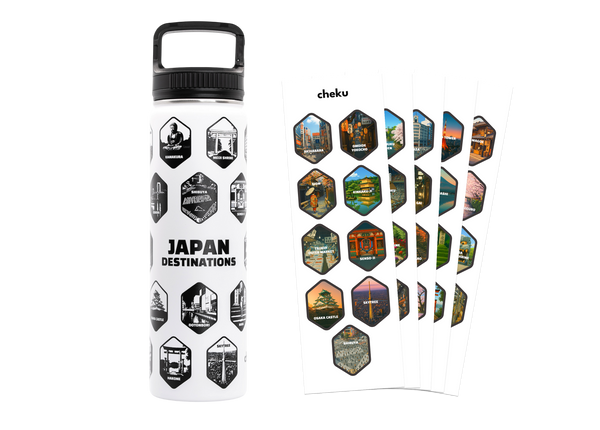
For your first trip to Japan
The Traveler Bottle
27 of Japan's most iconic destinations across Tokyo, Kyoto and Osaka, laser-engraved on a stainless steel bottle. The places you cannot miss on a first trip.
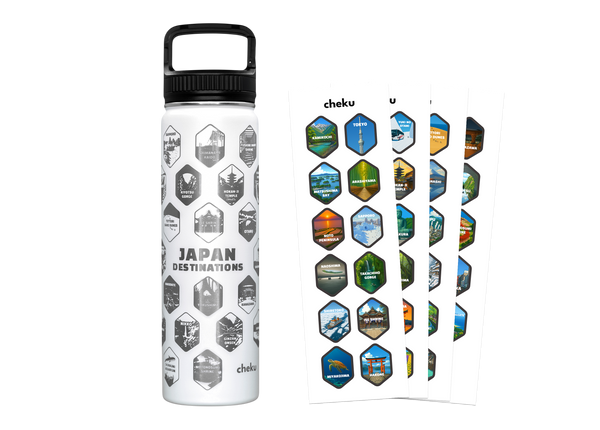
For living in Japan
The Explorer Bottle
46 destinations across 31 prefectures, for travelers and residents ready to go past the highlights. The deeper Japan bucket list.
The bottle that holds your trip
The Japan Destinations Bottle launches June 15
Our first campaign drops on Kickstarter at 9am JST on June 15. Backers get early pricing for the first 48 hours, and the list gets the link before anyone else.
Go deeper
Read these before you book

Souvenirs
What You Can Actually Buy in Japan for 100 Yen
Japan's 100-yen shops, convenience store basics, and gachapon: what you actually get for ¥100 and which categories are genuinely worth buying at that price point.
Read the guide →

Japan Travel Planning
How Much Does a Japan Trip Cost? What 100+ Real Travelers Actually Spent
What a Japan trip really costs in 2026, from 100+ real travelers: per-day and total budgets, flights, hotels, food, and whether the JR Pass still pays off.
Read the guide →

Souvenirs
Cheap vs. Premium Souvenirs in Japan: What's Worth the Money
Cheap Japan souvenirs versus the upgrade tier: a category-by-category breakdown of what's worth paying more for and what's genuinely fine at the konbini and ¥100 shop tier. Sourced from Japanese consumer media.
Read the guide →

Souvenirs
Unique Japanese Souvenirs Under ¥5,000 Worth Buying
Unique Japanese souvenirs under ¥5,000 — stationery, kitchen tools, craft objects, and pantry goods that are genuinely Japanese, distinctive, and fit the budget. Sourced from Japanese media.
Read the guide →
Before you book
Japan trip budget, answered
How much does a trip to Japan cost?
A comfortable mid-range trip lands around ¥18,000 to ¥25,000 ($120 to $170) per person per day once you are in the country, before flights. Budget travelers using business hotels, konbini meals and trains run closer to ¥9,000 to ¥12,000. Luxury trips with ryokan stays and omakase counters easily reach ¥45,000 and beyond. The calculator above builds a real number from your trip length, group size and travel style.
Is the JR Pass worth it in 2026?
Usually not. Since the October 2023 price hike, the 7-day pass jumped from roughly ¥29,650 to ¥50,000. For the standard Tokyo, Kyoto and Osaka loop, individual Shinkansen tickets come in cheaper. The pass becomes worthwhile only on long-distance itineraries that include Hiroshima, Hokkaido, or both ends of the country in the same week.
How much does a 10-day or 14-day trip to Japan cost?
For a comfortable mid-range trip, budget around ¥200,000 to ¥280,000 ($1,350 to $1,900) per person on the ground for 10 days, and ¥280,000 to ¥400,000 ($1,900 to $2,700) for 14 days. Both figures sit before international flights and assume business hotels, Shinkansen between two or three cities, and a balanced mix of konbini, casual restaurants and one or two splurge meals. Add 30 to 50% for ryokan stays and tasting-menu dinners.
How much is a 7-day trip to Japan?
For a typical first trip through Tokyo, Kyoto and Osaka, budget around ¥150,000 to ¥200,000 ($1,000 to $1,350) per person on the ground, plus international flights. That covers business hotels, Shinkansen travel between cities, three meals a day at a mix of price points and a handful of paid attractions. The calculator above takes a stronger swing at the number once you pick your travel style.
Can you use credit cards everywhere in Japan?
In cities, mostly yes. Beyond cities, not always. Tokyo, Kyoto and Osaka cover most chain restaurants, hotels and department stores with Visa, Mastercard, JCB and Amex, plus tap-to-pay through Apple and Google Pay. Smaller restaurants, shrines, ryokan, taxis outside city centres, and most vending machines stay cash-only or cash-preferred. Carry around ¥10,000 a day in mixed notes alongside the card.
How much cash should I bring to Japan?
Carry around ¥10,000 in mixed notes and coins per day to start, then top up from any 7-Eleven konbini ATM. Card acceptance has improved sharply, and tap-to-pay works on every train, but small restaurants, shrines, vending machines and most ryokan stay cash-only or cash-preferred. The 7-Eleven ATM takes foreign cards 24/7 in English.
What is the daily ATM withdrawal limit in Japan?
At 7-Eleven (Seven Bank) ATMs, foreign cards can pull up to ¥100,000 ($670) per transaction on chip cards and ¥30,000 on older magnetic-stripe cards. Your home bank may set a tighter daily cap. Withdrawals between 7pm and 7am add a ¥110 fee. Seven Bank ATMs sit inside the konbini network, work in English and take Visa, Mastercard, Amex, JCB and UnionPay around the clock.
How much does food cost in Japan?
Budget ¥3,000 to ¥6,000 per person per day for a mix of konbini breakfasts, ramen or set-menu lunches, and a casual izakaya dinner. A full konbini day runs around ¥1,500. A proper kaiseki dinner or omakase counter starts around ¥15,000 per head. The calculator above splits food across breakfast, lunch and dinner so the daily figure reflects how you actually plan to eat.
Do you tip in Japan?
No, and trying often causes confusion. Service is included in the bill at restaurants, bars, hotels and taxis, and staff will sometimes chase you down the street to return notes left behind. The polite gesture instead is a hand on the chest and a short 'gochisousama deshita' (thank you for the meal) on the way out. The one exception is private guides, where a small thank-you in a sealed envelope is sometimes accepted.
How much does the bullet train from Tokyo to Kyoto cost?
A reserved seat on the Nozomi Shinkansen runs about ¥14,170 ($95) one-way and takes 2 hours 15 minutes. Tickets are bought at the green JR ticket machines, the Smart-EX app, or the station office. The same route on an overnight bus drops to roughly ¥9,000 ($60), takes seven hours and doubles as a night of accommodation. The bus is worth doing once on this leg.
Is Japan more expensive than other Asian countries?
Yes, but less than most travelers expect. A mid-range day in Tokyo at roughly ¥18,000 ($120) sits above Bangkok or Bali (closer to $50 to $70), in line with Seoul and Taipei, and below Singapore and Hong Kong. The headline costs, Shinkansen and ryokan, push Japan above its neighbours. Konbini food, museum entry, public transport and most casual restaurants stay a clear bargain.
What is the cheapest time to visit Japan?
January through early March and June through early July are the cheapest windows. Flights from North America and Europe land 20 to 35% below sakura and autumn-foliage prices, and hotels follow. The trade-off is weather (cold winters, the early rainy season in June) and fewer headline festivals. Avoid Golden Week (late April), Obon (mid-August) and New Year, which are the most expensive weeks of the year for everything.
Is Japan expensive to visit?
Less than most travelers expect. The exchange rate has held around ¥150 to the dollar through 2025 and 2026, making Japan roughly 30% cheaper for US visitors than it was a decade ago. Tokyo costs land between New York and a mid-sized European capital. Trains, konbini food and museum entry are notable bargains. Hotels, ryokan, taxis and beef sit on the higher end.
What is the hidden cost most Japan travelers underestimate?
Luggage handling. Across the budget breakdowns we studied, takkyubin (¥2,000 per bag to ship between hotels), coin lockers (¥600 a day at the major stations) and a second suitcase home (¥15,000 to ¥30,000 in airline overweight fees or a new bag) added up to ¥40,000 to ¥70,000 on a typical two-week trip. The fix is to pack lighter than you think, and to budget the shipping fee in upfront.
How does the cheku budget calculator work?
Pick your trip length, group size and travel style. We add up flights, accommodation, transport, food, activities, shopping and shipping using benchmarks digested from 100+ real Japan budget breakdown videos (2025–2026) at roughly ¥150 to the dollar. Estimates are a confident starting point, not a quote, and the calculator shows you what each line item assumes so you can adjust as you plan.