
A bucket list for Japan changes shape after the first trip. The corridor is done; what remains is the country Japanese travelers keep for themselves: Shiretoko's bear coast, Ginzan Onsen's gaslights, the Ine boat houses, Naoshima's art sea, Yakushima's ancient cedars. Thirty places, five regions, four to six trips' worth of reasons to return.
The data says what repeat travelers already feel: the honichi.com inbound analysis found that the more visitors return to Japan, the more completely they abandon the standard corridor for regional Japan, with repeat visitors from Korea, Taiwan and Hong Kong reaching the regions at rates near 100 percent. The first trip is the introduction. This bucket list for japan is the rest of the book.
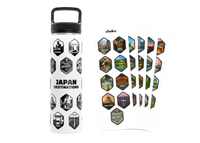
We curated these 30 from the same map our Explorer Bottle illustrates, 46 destinations across 31 prefectures, and grouped them the way return trips actually get planned: by region, one zone per journey.
The Explorer bucket-list bottle is built for locals, residents, and repeat travelers who already know the obvious places — 46 destinations across 31 prefectures, the parts of Japan that don't make first-trip guides. Live on Kickstarter until July 26. Reserve yours now at the best prices we'll offer.
What does the north hold?
Seven entries and the country's biggest skies: Shiretoko's World Heritage coast, Furano's July lavender, Tomamu's dawn cloud sea, Otaru and Hakodate's port-town light, Matsushima Bay, and Ginzan Onsen's gaslit street.
1. Shiretoko. The peninsula carries World Natural Heritage status per Rakuten Travel, and it is Japan at its wildest: capes, drift ice, bears. 2. Furano. The lavender valley Japanese summer travel is built around. 3. Tomamu. Wake in the dark for the unkai, the sea of clouds filling the valley at sunrise. 4. Otaru. The canal town's herring-boom architecture and glasswork, best in snow. 5. Hakodate. The southern port and its hill-top night view, gateway to the whole island; plan it with our Hokkaido guide. 6. Matsushima Bay. Tohoku's pine-island seascape, one of Japan's canonical three views. 7. Ginzan Onsen. The Taisho-era hot-spring street whose gaslights and snowfall built a thousand screensavers; go midweek, midwinter.
Where does the mountain spine reward the detour?
Eight entries down Honshu's back: Nikko's shrine forests, Kusatsu and Karuizawa, Kamikochi's alpine valley, Shirakawa-go's thatched village, Kanazawa's crafts, the Noto coast, and the Kiyotsu Gorge tunnel.
8. Nikko. The shrine-and-cedar complex that rewards an overnight after the day-trippers leave. 9. Kusatsu Onsen. The hot-spring town built around its steaming yubatake source. 10. Karuizawa. The highland resort where Tokyo has summered for a century. 11. Kamikochi. The car-free alpine valley that is the Japanese Alps' front parlour. 12. Shirakawa-go. The gassho village, 114 thatched farmhouses and a living community of about 630 per mapple; our full guide plans the day. 13. Kanazawa. Kenrokuen, the samurai and chaya districts, and the craft economy that never stopped. 14. The Noto Peninsula. The Japan Sea coast at its most weathered and quiet. 15. Kiyotsu Gorge. The Niigata tunnel whose mirror-pool frame turned civil engineering into pilgrimage art.
A photographer's note for this spine: it is Japan's best argument for traveling in bad weather. Mist in Kamikochi, snowfall on Shirakawa-go's roofs, the Noto coast under storm light: the mountain entries reward exactly the forecasts that cancel beach plans. Pack the rain cover and go anyway.
❤️ For travelers building a longer Japan itinerary, the Explorer Bottle illustrates 46 destinations across 31 prefectures — with stickers to mark off each one as you visit, designed for locals, residents, and repeat travelers. Live on Kickstarter until July 26. Reserve yours now at the best prices we'll offer.
What do the sea roads offer?
Seven entries along two coasts: Ine's boat-house village and the Amanohashidate sandbar on the Japan Sea, then the Seto side's Naoshima art island, the Shimanami Kaido cycling route, Kurashiki's canal quarter, Himeji's white castle, and the Tottori dunes.
16. Ine. Roughly 230 funaya boat houses ring the bay, boats garaged below and life above, the first fishing village named a national preservation district per mapple's Kyoto-region guide. 17. Amanohashidate. The 3.2-kilometer pine-covered sandbar, one of the classical three views: walk it in an hour or cycle it in twenty minutes, per the same source. 18. Miyama. Ine's inland sibling, a thatched-roof village still farming its valley. 19. Naoshima. The art island: museums, installations and sculpture against the Seto Inland Sea, one unhurried cycling day. 20. The Shimanami Kaido. The island-hopping cycle route across the Seto bridges, Japan's best two-wheeled day. 21. Kurashiki. The white-walled canal quarter and its historic textile wealth. 22. Himeji Castle. The white heron, the one castle that out-performs its photographs. 23. The Tottori Sand Dunes. Japan's improbable desert, best at dawn before the footprints.
Free for you: our Tokyo Google Maps list We keep a Google Maps list of the must-see spots around Tokyo - restaurants, cafes, shops, viewpoints, and streets worth the detour. Drop your email and we'll send it over.
Where does the pilgrim south lead?
Five entries of shrine, steam and volcano: Ise's Grand Shrine, the Nachi falls-and-pagoda frame on the Kii Peninsula, Miyajima's floating torii, Beppu's steaming districts, and Aso's vast caldera, with Takachiho's gorge and Sakurajima close behind.
24. Ise Grand Shrine. Shinto's home shrine, rebuilt each generation, the south's spiritual anchor. 25. Nachi and Seiganto-ji. The Kii Peninsula frame where a vermilion pagoda stands before one of Japan's tallest falls, the single image of pilgrim Japan. 26. Miyajima. The floating torii among the official three views, with Mount Misen rising 535 meters behind it, a ¥2,000 ropeway to the summit panorama per じゃらん's review-ranked zekkei list. 27. Beppu and Aso. Kyushu's double act: the steaming onsen capital and the vast volcanic caldera an hour inland, with Takachiho Gorge and Sakurajima extending the circuit for longer trips.
Which far islands finish the list?
The three-entry finale: Yakushima's ancient cedar forest, the Yaeyama pair of Ishigaki and Miyakojima, and Okinawa's Churaumi aquarium standing in for the whole subtropical arc.
28. Yakushima. The mossy cedar island whose oldest trees predate empires; one full muddy day minimum. 29. Ishigaki and Miyakojima. The Yaeyama blues, Japan's own coral latitudes, flights-required and worth it. 30. The Okinawa arc. Churaumi's whale sharks as the gateway, the outer islands as the graduation.
First return trip: take the mountain spine in autumn, entries 8 through 15; it is the highest density of wonder per rail pass. The summer escape: the north, entries 1 through 7, while the corridor swelters. The trip you plan longest for: the far islands, entries 28 through 30, and accept that they will demand a fourth trip.
However you sequence them, this is the half of the bucket-list project the first trip cannot touch, the trip-of-a-lifetime tier stretched across a life's worth of returns, region by region through all 47 prefectures. Japanese travelers spend decades on this map. That is not a warning. It is the invitation.
❤️ If you've already done Tokyo and Kyoto and want to go deeper, the Explorer bucket-list bottle covers 46 Japan destinations across 31 prefectures — with stickers to check off as you visit, from Hokkaido to Okinawa. Live on Kickstarter until July 26. Reserve yours now at the best prices we'll offer.
FAQ
Where should I go on my second trip to Japan?
Where Japanese repeat visitors go: regional Japan. Inbound data shows returning travelers overwhelmingly disperse beyond the Tokyo-Kyoto corridor, and the rewards cluster into five zones: the wild north, the mountain spine, the Seto and Japan Sea coasts, the pilgrim south, and the far islands. Pick one zone per trip.
How many trips does this list take?
Honestly, four to six, and that is its design. The 30 places group into regional clusters that each fill a one-to-two-week trip: a Hokkaido-and-north summer, a mountain-spine autumn, an island-hopping spring. A bucket list for Japan is a relationship plan, not an itinerary.
Is regional Japan hard to travel without Japanese?
Harder than Tokyo, gentler than its reputation. Trains and buses reach most of this list, signage increasingly carries English, and the pointing-and-goodwill system works everywhere. A rental car unlocks the rest. The places repay every extra logistics minute with the Japan crowds never see.
Sources
- honichi.com / 訪日ラボ — インバウンド×ゴールデンルート — the repeat-visitor regional dispersal data (2019)
- Rakuten Travel — 北海道の観光名所72選 — Shiretoko's World Natural Heritage status and the northern entries
- mapple.net — 白川郷スポットガイド — Shirakawa-go's village figures
- mapple.net — 京都の冬のおすすめ観光スポット20選 — Ine's boat houses, Miyama, Amanohashidate's sandbar figures
- jalan.net — 日本の絶景13選 — Miyajima and Mount Misen figures
Activities and tours in Tokyo
cheku is a GetYourGuide partner. We link to tours that handle the parts of travel that eat your time, getting there, booking ahead, language, context you'd otherwise miss. If you book through our link, we earn a small commission at no extra cost to you.


