
Most of what travelers pack for Japan, they do not need. You do need some cash, a way to get mobile data, and a plug adapter if you are not coming from North America. You can leave the voltage converter, the hair dryer and most of your toiletries at home. Japan sells the rest, often better and cheaper than you can at home.
"Do you need cash in Japan?" is one of the most-asked questions a first-time visitor has, and it sits inside a bigger one: what do you actually need to bring at all? We went through more than 200 recent Japan packing guides and budget breakdowns, and the pattern was consistent. Travelers pack a pile of things Japan quietly makes redundant, then occasionally skip one of the few things that genuinely matter.
This guide answers the real questions one at a time: cash, plug adapters, voltage, mobile data, the JR Pass, and what you can drop from the bag entirely. For each, the honest answer and whether it earns its space.
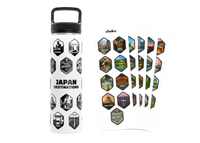
If you would rather see the whole packing picture at once, our free Japan packing checklist builds a season-by-season list you can tick off. And the Traveler Bottle maps 27 of Japan's destinations, a good way to picture the trip you are packing for.
Do you need cash in Japan?
Yes, bring some cash, but less than Japan's cash-only reputation suggests. Japan has moved a long way toward cards and IC payments, and a card-only traveler can now get through most of a trip. The gaps are specific and worth planning for.
Cards and tap-to-pay work reliably at hotels, chain restaurants, department stores, convenience stores and most mid-size shops. Where you still need cash: small local restaurants, older family-run shops, shrine and temple entry fees, some market stalls, and coin lockers at stations.
The practical approach travelers settle on is to carry roughly ¥10,000 to ¥20,000 at a time and top up when it runs low. The reliable place to withdraw is a 7-Eleven ATM, which takes foreign cards and appears on almost every block. Airport exchange counters give poor rates, so withdraw a small amount on arrival and use the konbini ATMs after that.
One small thing nobody warns you about: you will accumulate coins fast, because so many small purchases settle in cash. A slim coin purse genuinely helps.
One thing you do not need to budget for at all is tipping. Japan does not have a tipping culture. Not in restaurants, not in taxis, not at hotels. The price on the menu or the meter is the price you pay, and trying to leave a tip can cause polite confusion, or a server following you out to return what they assume is forgotten change. For travelers used to adding 15 to 20 percent to every bill, that is a real saving, and it makes daily budgeting in Japan refreshingly simple. For the wider money picture, our Tokyo budget guide breaks down what daily spending actually looks like.
Do you need a power adapter for Japan?
This depends entirely on where you are flying from, and it is the single most common point of confusion. Japan uses the Type A plug, the two-flat-pin design.
From the US or Canada: you need no adapter at all. Japan's plug is the same shape you already use. From the UK, Europe, Australia or most of Asia: you need a simple Type A plug adapter. A single small one is enough.
That is the whole answer. There is no need to buy a heavy universal adapter or a travel power station. A basic plug adapter the size of a matchbox covers everything, and if you forget one, any Don Quijote or electronics shop sells them cheaply.
Do you need a voltage converter for Japan?
Almost certainly not. This is one of the most over-packed items for Japan, and it usually goes home unused.
Japan runs on 100 volts. Nearly every modern device you would travel with, your phone charger, laptop charger, camera battery charger, tablet, is already dual-voltage. Check the small print on the charger itself: if it reads "100 to 240V," it works in Japan with nothing more than the plug adapter above.
The only things that genuinely care about voltage are high-wattage heat appliances, mainly hair dryers, straighteners and curling irons. If one of those is not labeled dual-voltage, it can underperform or burn out in Japan. The fix is not a converter, which is bulky and unreliable for heat appliances anyway. The fix is in the next section.
Do you need to pack a hair dryer or toiletries for Japan?
No to the hair dryer, and pack far less than you think for toiletries. Both are space you can reclaim.
Effectively every hotel in Japan, including business hotels and most guesthouses, provides a hair dryer in the room. Packing your own is carrying a heavy appliance to use a tool that is already waiting for you. If you rely on a specific straightener or curler, bring it only if it is dual-voltage, and accept that you are bringing it for that reason alone.
Toiletries are the same story. Japanese hotels stock the basics: soap, shampoo, conditioner, a toothbrush, often more. And Japan's drugstores are genuinely world-class, stocked with skincare and everyday items that travelers usually end up buying anyway. Bring your prescription medication and the few products you cannot do without, then leave the rest. You will want the room.
Do you need a SIM card or pocket wifi for Japan?
You need mobile data, yes, but a physical SIM card is now the least convenient way to get it. Japan is hard to navigate without data for maps, translation and train times, so this is one thing worth sorting properly.
The cleanest option for most travelers is an eSIM. You buy it online before you fly, and it activates when you land, with no physical card to swap and nothing to collect at the airport. Most phones from the last few years support it.
A pocket wifi device is the better choice in two cases: you are traveling as a group and want to share one connection, or you are carrying several devices. It is one more thing to charge and return, so for a solo traveler the eSIM wins.
Whichever you choose, arrange it before departure. Landing without data and trying to solve it at the airport is a slow, expensive start to a trip.
Do you need a JR Pass?
For most travelers in 2026, no. The Japan Rail Pass was once automatic advice. Since the 2023 price increase, it is not.
The 7-day JR Pass now costs around the price of a long-haul flight's worth of train travel, and it only pays off if your itinerary is genuinely train-heavy. For a Tokyo-only trip, you do not need it at all, an IC card such as Suica or Pasmo covers every city train and bus. For the standard Tokyo, Kyoto and Osaka loop, individual tickets usually come out about the same or cheaper, with none of the pass's date restrictions.
Buy point-to-point tickets unless you are covering serious long-distance ground, for example adding Hiroshima or the far north. Our transport guide walks through the IC card and JR Pass decision in full, and the Japan budget calculator runs the comparison for your exact route.
Free for you: our Japan packing checklist Pick your travel month and get a season-built checklist you can tick off as you pack, with the items that matter and the ones to skip. Drop your email and we will send the full trip planner too.
What should you bring, and what should you skip?
The short version: bring the few things Japan cannot quickly hand you, and skip everything Japan sells better. Here is the decision in one view.
| Item | Verdict | Why |
|---|---|---|
| Cash (¥10,000–20,000 at a time) | Bring | Small shops, temples, markets and lockers still need it |
| Plug adapter (Type A) | Bring unless from US/Canada | North American plugs already fit; everyone else needs one |
| eSIM or pocket wifi | Bring / arrange | Japan is hard to navigate without data |
| Prescription medication | Bring | Some foreign medicines are restricted or hard to find |
| Comfortable, broken-in walking shoes | Bring | You will walk 10,000 to 20,000 steps a day |
| Voltage converter | Skip | Modern chargers are already dual-voltage |
| Hair dryer | Skip | Every hotel provides one |
| Most toiletries | Skip | Hotels supply basics; drugstores cover the rest |
| A third of your clothes | Skip | Coin laundries are everywhere, and you will buy clothes there |
| A second empty bag | Bring | You will leave Japan with more than you arrived with |
The thread running through the "skip" column is the same one travelers name as their biggest packing regret: overpacking. The bag you bring half-empty is the bag that comes home full. For the season-specific version of this list, the packing checklist tool does the sorting for you.
FAQ
Do you need cash in Japan? Yes, but less than you would expect. Cards work at hotels, chains, department stores and konbini. Keep ¥10,000 to ¥20,000 in hand for small restaurants, temples, markets and lockers, and refill at a 7-Eleven ATM.
Do you need a power adapter for Japan? Only if you are not from North America. Japan uses the Type A plug, the same as the US and Canada. Travelers from the UK, Europe, Australia and most of Asia need a simple Type A adapter.
Do you need a voltage converter for Japan? Almost never. Phone, laptop and camera chargers are already dual-voltage. Only non-dual-voltage hair tools have a problem, and the answer there is to leave them home, not to carry a converter.
Do you need a SIM card for Japan? You need data, not necessarily a SIM. An eSIM is simplest for most phones; a pocket wifi suits groups and multi-device travelers. Arrange it before you fly.
Is the JR Pass worth it in 2026? Usually not. Since the 2023 price rise it only pays off on train-heavy itineraries. Tokyo-only trips need just an IC card, and for the Tokyo, Kyoto and Osaka loop individual tickets are typically cheaper.
How we sourced this: the answers above are drawn from more than 200 recent Japan packing guides and budget-breakdown videos (2025 to 2026), cross-checked against what travelers consistently reported using, skipping and regretting. Rules on plugs, voltage and the JR Pass are current as of 2026.
Activities and tours in Tokyo
cheku is a GetYourGuide partner. We link to tours that handle the parts of travel that eat your time, getting there, booking ahead, language, context you'd otherwise miss. If you book through our link, we earn a small commission at no extra cost to you.


