
Japan's transport system has a reputation for being complicated. It's not. It just looks that way from the outside. After seven years living in Tokyo, the system reduces to three actions: get an IC card on arrival, use Google Maps for routing, and decide on the JR Pass based on your actual route rather than by default. With those three things, getting around Japan becomes one of the easiest parts of the trip.
The complexity people associate with Japanese transit comes from the fact that multiple operators run trains and subways, ticket types vary, and Shinkansen tickets work differently from local tickets. None of this matters to the visitor in practice. The IC card handles everyday Tokyo travel; Shinkansen tickets are bought separately; Google Maps gives you the routing.
This guide covers what you actually need to know after landing, the JR Pass decision (which has changed since 2023 price hikes), the Shinkansen, taxi apps, and the three things that save first-timers.
For the cost side of moving around Japan, Tokyo on a Budget covers what each transit type actually runs at.
What do you need before you arrive in Japan?
Two things to set up before flying: a Mobile Suica or Pasmo in your phone wallet, and Google Maps with offline Japan maps downloaded. Both take 10 minutes and remove most first-day friction.
Mobile Suica or Mobile Pasmo (iPhone or Apple Watch only). Open Apple Wallet, add a transit card, select Suica or Pasmo, and top up with a credit card (Visa, MasterCard, Amex all work). You now have a working Tokyo transit card before you land. Tap your phone at the gate the same way you'd tap a physical card. Android Pay supports a more limited version through Google Pay in some regions.
Google Maps offline Japan. Open Google Maps, search "Japan," tap the country, and download the offline map. The transit directions still work without data, including line names, platform numbers, walking directions, and transfer instructions in English. This is what gets you from the airport to your hotel on day one.
That's it for prep. Everything else can wait until you're on the ground.
How do you get an IC card if you didn't set up Mobile Suica?
Pick up a Welcome Suica or Pasmo Passport at the airport immediately on arrival. Both major airports have visible counters.
At Haneda: Welcome Suica counter at the International Arrivals exit (1F) or any JR ticket machine. ¥1,500, takes cash or credit. Expires 28 days after activation. No refund.
At Narita: Welcome Suica or Pasmo Passport counter at the arrival level. Same pricing.
Welcome Suica vs. regular Suica. The Welcome Suica is the visitor version: ¥1,500, expires after 28 days, no refund. The regular green Suica costs ¥2,000 (including a ¥500 refundable deposit) and lasts 10 years. For a single trip, Welcome Suica is fine.
How to use it. Tap when you enter the ticket gate, tap when you exit. The card deducts the fare automatically. Top up at any ticket machine, station Suica machine, or convenience store ATM. Minimum top-up is usually ¥1,000.
What it works on. Every train, subway, and most buses across the Tokyo area, plus Osaka, Kyoto, Sapporo, Fukuoka. Basically every major city. Also works at convenience stores, vending machines, and some restaurants for payment. The single card covers most daily small transactions.
How do you get around Tokyo specifically?
Tokyo has three rail operators visitors actually use: JR East, Tokyo Metro, and Toei Subway. Your IC card works on all of them. JR East and Tokyo Metro publish English route maps that match what you'll see in stations.
JR East lines (the green-symbol JR). The Yamanote Line is the circular loop connecting major districts: Shinjuku, Shibuya, Harajuku, Akihabara, Ueno, Tokyo Station, Shinagawa. The Chuo Line cuts across the city east-to-west. The Sobu Line runs to Akihabara from the east. JR is also what you take to leave Tokyo (Shinkansen, Shonan-Shinjuku to Yokohama, etc.).
Tokyo Metro (orange-and-blue logos). Nine subway lines. Marunouchi, Ginza, Hibiya, Chiyoda, Yurakucho, Hanzomon, Namboku, Tozai, Fukutoshin. All English-signed. Each line has a color and a letter. Stations use a number system (Ginza Line = G, so Asakusa is G19).
Toei Subway (different logo, smaller operator). Four lines. Asakusa (A), Mita (I), Shinjuku (S), Oedo (E). Used in combination with Tokyo Metro to reach corners of the city the major lines don't cover.
Routing in practice. Open Google Maps, type your destination, follow the transit directions. The app picks the fastest route across operators and tells you which platform to use. The fare appears at the gate when you tap out.
Operating hours. Trains run roughly 05:00 to midnight. The last trains are 23:45–00:30 depending on the line. Missing the last train means a taxi (¥3,000–8,000 in central Tokyo) or a 24-hour manga café (¥2,500 for an overnight booth). Friday nights are when most foreigners get caught. Start heading home before midnight if you don't want to deal with this.
Rush hour. 07:30–09:00 and 17:30–19:00 are when Tokyo's rush hour earns its reputation. Shinjuku, Tokyo Station, and Ikebukuro at peak rush are intense. Stations have signs showing percent capacity for each platform; avoid the 200% trains if you can. Traveling outside these windows when possible is the most useful Tokyo transit habit.
For neighborhood-specific routing, Things to Do in Shinjuku covers Shinjuku Station's exits and platform layout in detail. Things to Do in Shibuya covers Shibuya. Things to Do in Asakusa covers the east-side lines.
Is the JR Pass still worth buying?
The JR Pass is no longer the default deal it used to be. Japan Rail Pass prices jumped roughly 70% in October 2023, and the 14-day pass now runs around ¥50,000. The break-even maths has shifted.
The new break-even. The 14-day JR Pass at ¥50,000 covers unlimited JR travel including most Shinkansen. To break even, you need around three Shinkansen long-distance journeys (Tokyo-Kyoto round trip alone is ~¥27,000 at standard fares). Realistic itineraries that still make the JR Pass worth it:
- Tokyo → Kyoto → Hiroshima → back plus day trips to Nikko or Hakone. Worth it.
- Tokyo → Kyoto → Osaka → back plus extensive Tokyo Yamanote use. Marginal; check specific dates.
- Tokyo + day trips to Kamakura, Nikko, Hakone. Not worth it; pay per ride.
- Tokyo only. Not worth it.
- Tokyo → Kyoto round trip. Marginal; usually slightly cheaper to pay per ride.
Jalan.net's transit value analysis tracks this every year. The regional passes (JR East Tohoku Pass, JR West Kansai Pass, Hokkaido Pass) are now better value for many itineraries because they're cheaper and cover the relevant routes.
The catch with the JR Pass: no Nozomi or Mizuho. The fastest Shinkansen trains aren't covered, so you take the slightly slower Hikari instead. For most intercity routes this adds 10–25 minutes. For Tokyo-Kyoto the difference is 20 minutes.
How to decide. Add up your planned Shinkansen and JR line tickets at standard fares (use Jorudan or HyperDia route planners). Compare to the pass price. If pass + 10–15% is less than your total, get the pass. Otherwise, pay per ride.
How to buy. The JR Pass is sold both inside and outside Japan. Outside Japan you buy an exchange order which you redeem at major JR stations. Online via the official JR Pass site is the easiest. Some travel agencies offer slight discounts.
How does the Shinkansen actually work?
The Shinkansen is one of the genuinely great transportation experiences in the world. Two things to know: which train type, and how to book seats. JR Central operates the main Tokyo-Osaka-Hiroshima corridor.
Train types (Tokaido Shinkansen): - Nozomi: fastest. All-reserved-seat. Not covered by JR Pass. - Hikari: slightly slower, fewer stops. Mix of reserved and non-reserved seats. Covered by JR Pass. - Kodama: slowest, stops at every station. Mostly non-reserved. Covered by JR Pass.
For Tokyo-Kyoto, Nozomi is 2h 15min, Hikari is 2h 40min, Kodama is 4h. Hikari is the JR Pass default; Nozomi is the time-priority option.
Key route times: - Tokyo → Kyoto (Hikari): ~2h 40min - Tokyo → Osaka (Hikari): ~2h 50min - Osaka → Hiroshima (Hikari): ~1h 30min - Tokyo → Hakone (via Odawara, Hikari): ~45min
Window seats on the right side heading west from Tokyo give you Mount Fuji views on clear days. Try to get seat E (right window) for Tokyo→Kyoto. The Mount Fuji view is best around 30–40 minutes into the trip.
Booking. With JR Pass: reserve seats at any major JR station or via the JR Central ticket machines. Without JR Pass: buy at the green Midori-no-Madoguchi ticket window or at JR machines with English options. SmartEX is JR Central's official online booking app, useful for credit card purchases without queues.
Bento on the Shinkansen (ekiben). Picking up a regional ekiben at the station before boarding is the standard Japanese travel experience. Tokyo Station's Ekibenya Matsuri concentrates bento from across Japan; smaller stations have local ekiben specific to their region. Eat at your seat; the Shinkansen specifically allows and expects this.
Free for you: our Tokyo Google Maps list We keep a Google Maps list of the must-see spots around Tokyo: restaurants, cafes, shopping districts, viewpoints, and the things actually worth the detour. Drop your email and we'll send it over.
How do you get from the airport to Tokyo?
From Haneda: the easiest. Multiple direct routes; all take Suica.
- Keikyu Line. Direct to Shinagawa Station (15 minutes, ¥300). From Shinagawa, transfer to Yamanote Line for Shibuya, Shinjuku, Tokyo Station, etc. Keikyu also goes direct to Asakusa via the Toei Asakusa Line (45 minutes, ¥620).
- Tokyo Monorail. Direct to Hamamatsucho Station (20 minutes, ¥520). Transfer to JR Yamanote there.
- Limousine bus. Direct to many major hotels (¥1,300, 45–60 minutes depending on traffic).
From Narita: further out, but multiple good options.
- N'EX (Narita Express). Direct to Tokyo Station (60 minutes, ¥3,070), with continuing service to Shinjuku and Shibuya. Faster but expensive. Reserved seating.
- Keisei Skyliner. Direct to Ueno via Nippori (45 minutes, ¥2,580). Faster and cheaper than N'EX for travelers staying near Ueno/Asakusa or transferring to the Yamanote.
- Keisei Limited Express (Access Special). Slower regional train to Ueno (75 minutes, ¥1,050). Cheapest option; uses Suica.
- Airport Limousine bus. Direct to hotels (¥3,200, 80–120 minutes). Good for travelers with heavy luggage going to specific hotels.
Avoid taxis from Narita. Standard fare to central Tokyo is ¥20,000–25,000. Not worth it.
How do you get between Japanese cities?
Shinkansen for major routes, regional trains for shorter ones, domestic flights for Hokkaido and Okinawa. The basic logic:
- Tokyo → Kyoto, Osaka, Hiroshima: Shinkansen.
- Tokyo → Yokohama: Local JR or Tokyu Toyoko line (25–30 minutes; not Shinkansen).
- Tokyo → Hakone: Odakyu Romance Car or JR to Odawara (75–95 minutes).
- Tokyo → Nikko: Tobu Skytree Line or JR (~2 hours).
- Tokyo → Kamakura: JR Yokosuka or Shonan-Shinjuku Lines (~1 hour).
- Tokyo → Hokkaido: Domestic flight (1h 30min, ¥10,000–30,000) is faster than Shinkansen.
- Tokyo → Okinawa: Domestic flight only (2h 45min).
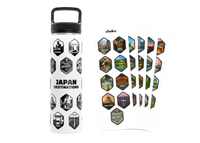
❤️ For first-time visitors building a multi-city Japan route, the Traveler bucket-list bottle covers 27 destinations across the country — part travel guide, part souvenir, part insulated bottle for the trip itself. Launching soon on Kickstarter.
What about taxis and Uber in Japan?
Taxis are abundant and reliable but expensive. Uber works limited; the Japanese app to use is GO.
Japanese taxis. Visible everywhere in major cities. Hail one on the street, pre-book at hotels, or use the GO app. Fares start at ¥500 (first 1.05km) and increase by ¥100 per ~250m. A typical 5km Tokyo ride is ¥1,500–2,500. Cleaner and safer than most cities, but expensive enough that they're for last-train situations, late-night transit, or moving with heavy luggage.
GO app. The default Japanese ride-hailing app. Pre-book or hail nearest taxi. Credit card payment integrated. English interface available. Works in most major cities.
Uber Japan. Limited Tokyo availability for premium service. Most cities use GO instead.
When taxis make sense: late night when trains stop, moving with multiple heavy bags between hotel and station, getting somewhere that's a long walk from a station. Otherwise, trains beat taxis on time and cost.
How do you handle luggage and getting around with bags?
Takkyubin (luggage forwarding) is the underused secret of Japanese travel. Yamato Transport and Sagawa Express run a same-day or next-day delivery service that sends bags from any hotel or convenience store to any other hotel in Japan.
Cost: ¥1,500–2,500 per bag depending on size and distance.
How to use it: at the front desk of any major hotel, ask for "takkyubin to [next hotel]." They give you a form, pack your bags, send them. The bags arrive the next afternoon. You travel light between cities. Bring a small overnight bag for the gap between drop-off and pickup.
Why it matters: moving with full luggage through Tokyo Station, Shinkansen platforms, and stairs is the most stressful part of Japan travel. Forwarding the bags eliminates this. Even one forwarding leg per trip (Tokyo to Kyoto, then Kyoto to airport) makes the difference between a smooth trip and a brutal one.
The konbini guide covers how to drop off and pick up packages at convenience stores too.
How do these Japan transit options compare?
| Trip type | Best option | Cost | Notes |
|---|---|---|---|
| Tokyo daily transit | Suica/Pasmo IC card | ¥150–500 per ride | Trains + subways + buses + konbini |
| Tokyo to Kyoto round trip | Shinkansen Hikari pay-per-ride | ~¥27,000 | Slightly cheaper than JR Pass alone |
| Tokyo–Kyoto–Hiroshima loop | 7-day JR Pass | ~¥33,000 | Break-even with this itinerary |
| Tokyo–Kyoto–Osaka–Hiroshima + day trips | 14-day JR Pass | ~¥50,000 | Worth it with full itinerary |
| Haneda to central Tokyo | Keikyu Line | ¥300–620 | Suica works; fastest |
| Narita to central Tokyo | Keisei Skyliner | ¥2,580 | Faster than N'EX, cheaper |
| Within Kyoto | Bus + subway (Suica) | ¥230 per bus ride | Buses are main transit |
| Tokyo–Hakone | Odakyu Romancecar | ¥2,470 | Direct seat reservation |
| Late-night Tokyo (after midnight) | Taxi or manga café | ¥3,000+ taxi, ¥2,500 booth | Avoid by leaving by 23:30 |
| Cross-city luggage moving | Takkyubin | ¥1,500–2,500 per bag | Hands-down best transit hack |
| Best for | First Japan trip | Suica + Google Maps + selective pass use | All you actually need |
What three things will save first-time visitors?
After seven years here, these are the three habits that separate easy trips from stressful ones.
1. Download Google Maps offline Japan before you leave home. Works without data. Gives you accurate transit directions including line, platform, transfer instructions, and walking routes. Combined with your IC card, this handles 95% of daily transit. The remaining 5% is asking station staff (who are helpful and often speak basic English).
2. Use takkyubin to forward bags between cities. ¥1,500–2,500 per bag from any hotel to any other hotel. Move between cities carrying only a day bag. The Tokyo-Kyoto journey becomes pleasant instead of brutal.
3. Keep ¥10,000–¥20,000 in cash at all times. Smaller restaurants, shrines, traditional shops, rural transit, and some food stalls are still cash-only. 7-Eleven ATMs (visible everywhere) reliably accept foreign Visa, MasterCard, and Amex cards with the usual withdrawal fees.
❤️ Two Weeks in Japan covers the route-and-transport logic across 200+ pages — Japanese travel writers' sequencing distilled, with our photography for each destination. Launching soon on Kickstarter.
FAQ
Do I need to speak Japanese to use Japanese transit? No. All major stations have English signage, English announcements on trains, and English maps. Google Maps directions are in English. Train staff at major stations often speak basic English. The IC card system removes most ticket-buying interactions entirely. Outside major cities, English signage thins out but Google Maps still works reliably.
Is Tokyo's train system safer than other big cities? Yes, much safer. Tokyo trains are clean, on time, and crime is rare. Pickpocketing is uncommon by international city standards. Stations are well-lit. The single risk is being caught after the last train, which is an inconvenience rather than a safety issue (taxis and manga cafés solve it). Women-only train cars run during rush hour on most lines for added comfort.
Can I use my home country credit card on Japanese trains? Some ticket machines accept foreign cards; most don't reliably. The simplest path: load your Mobile Suica or physical Suica with cash or credit at any station machine. For Shinkansen tickets, the Midori-no-Madoguchi (green window) at JR stations accepts all major credit cards.
Is Japan stroller and wheelchair accessible? Yes, increasingly so. Major stations have elevators and accessible entry gates. Older stations and some smaller stops are stairs-only. Tokyo Metro stations are almost universally accessible. Some Yamanote Line platforms still require careful planning. Google Maps' accessibility filter helps.
What time should you avoid using the trains? 07:30–09:00 weekday mornings and 17:30–19:00 weekday evenings are rush hour. The most-loaded lines (Saikyo, Chuo Rapid, Yamanote, Marunouchi) run at 150–200% capacity. If you can travel outside these windows, do it. Saturday and Sunday have no rush hour.
Sources
- JR East — JR East official, Yamanote and Tokyo-area lines, regional pass information
- JR Central — JR Central official, Tokaido Shinkansen routes and timing
- Tokyo Metro — Tokyo Metro subway lines and route planning
- Toei Subway — Tokyo metropolitan transit bureau, Toei subway and bus
- Jorudan — Japanese train route planner, accurate transfer information
- Japan Rail Pass Official — Official Japan Rail Pass information and pricing
- jalan.net — Japan domestic travel platform, transit option comparison


Activities and tours in Tokyo
cheku is a GetYourGuide partner. We link to tours that handle the parts of travel that eat your time, getting there, booking ahead, language, context you'd otherwise miss. If you book through our link, we earn a small commission at no extra cost to you.


